The first online meeting organized by the Polish Enamelling Industry Association (SPPE) concluded with great success in terms of both attendance and content quality. The event was attended by 47 participants from 7 countries, including Poland, Germany, France, Italy, the Czech Republic, the Netherlands, and Turkey. The agenda focused on two key areas: new regulations for the hot water tank market and technical aspects of the enamel firing process.
- New Regulatory Challenges: Drinking Water Directive
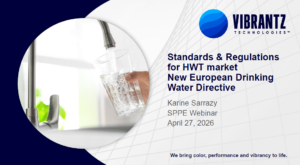
Karine Sarrazy from Vibrantz Technologies presented a comprehensive overview of the evolving regulations. Key points of the presentation included:
- DIN 4753-3 (2025-02): Although formally applicable in Germany, this standard is the most widely used reference across the European market for enamelled hot water tanks (HWT). It defines, among other parameters, the limits for enamel mass loss in the hot water resistance test (maximum 12 g/m²).
- European Directive 2020/2184: Introduces harmonization of the assessment of materials in contact with drinking water. New EU “positive lists” of substances will become mandatory from 31 December 2026 for new products, while the transitional period for existing products will end in 2032.
- Role of Industry Groups: Karine emphasized the importance of industry-wide cooperation (e.g. the Frit Consortium) in dialogue with ECHA to clarify migration limits for elements such as lithium, zirconium, and titanium.
- Furnace Atmosphere – the Key to Coating Quality
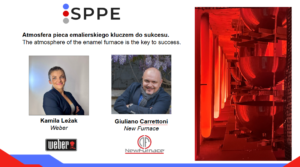
Experts Kamila Leżak (Weber) and Giuliano Carrettoni (New Furnace) discussed the impact of furnace conditions on the final quality of the enamelled component.
- Importance of Oxygen and Water Vapour: Proper furnace atmosphere requires an adequate oxygen level to ensure adhesion reactions and minimization of water vapour content.
- Risk of Defects: Studies show that furnace humidity exceeding 2.0% can lead to degassing defects (so-called “blisters”) and fish-scale defects.
- Monitoring and Diagnostics: Modern solutions were presented, such as the HELIOS MAGMA gas analyzer, which enables identification of radiant tube leaks and flue gas contamination (NOx, SO₂, CO).
Participants’ Feedback – What’s Next?
Participants rated the overall quality of the webinar very highly (4.8/5), with the subject matter rated at 4.53/5. As many as 100% of respondents declared their willingness to participate in future events.
Suggested topics for upcoming webinars included:
- Substrate preparation techniques (degreasing, pickling).
- Modern powder application methods.
- Analysis of real enamel defect cases (case studies).
Thank you to everyone for participating, and we invite you to follow SPPE updates!